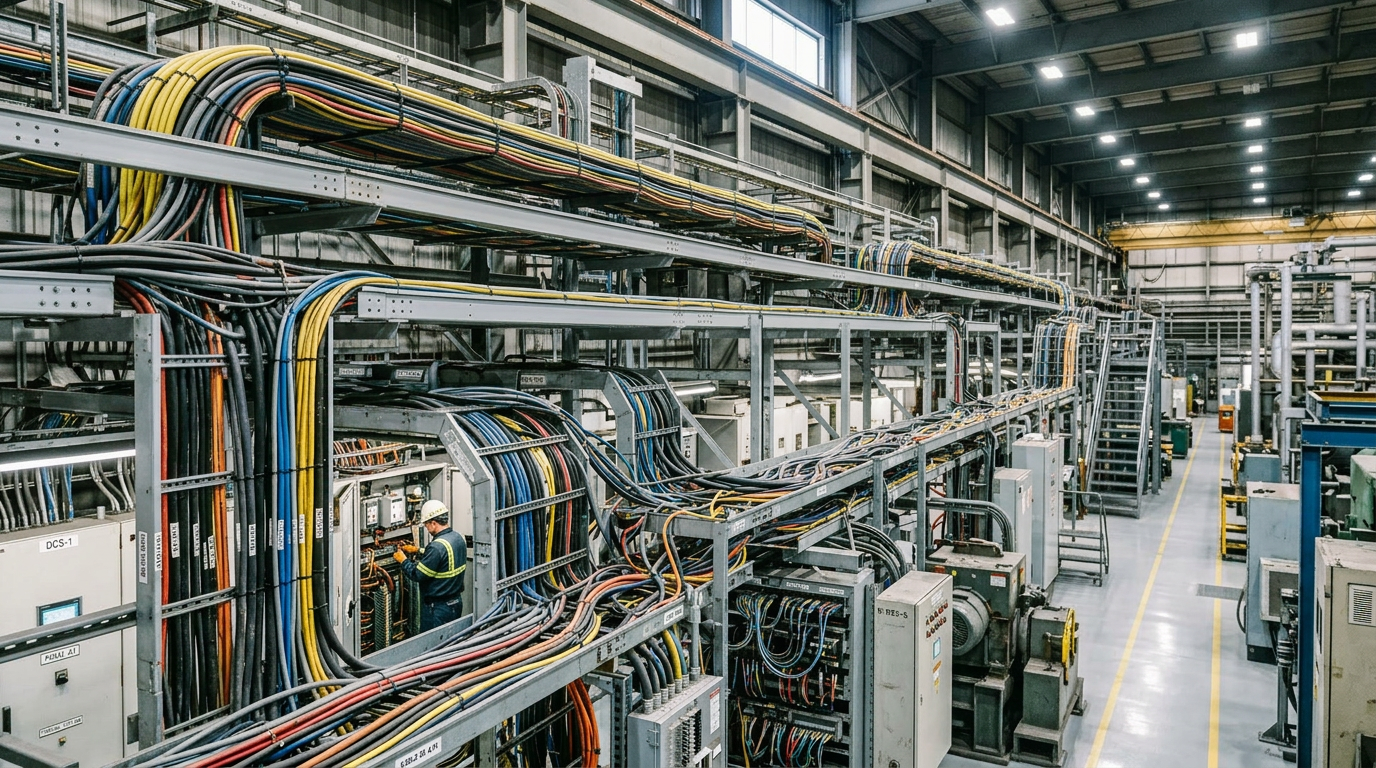
In complex engineering environments, certain activities appear routine but, in practice, determine the success of the entire project. Main line cable work is one such area.
While cables are often viewed as a physical installation task, experience shows that they are, in fact, a system-level exercise requiring planning precision, sequencing discipline and complete traceability.
Beyond Installation
At a surface level, cable work appears definable lengths, types, routes and terminations. However, in execution, the environment introduces complexity:
- Constrained physical spaces and dense routing
- Interdependencies with equipment and systems
- Limited or inconsistent legacy documentation
In such conditions, cable work becomes less about installation and more about reconstructing and understanding system architecture during execution.
Degutting as System Reconstruction
The process of degutting which is removal and identification of existing cables, is particularly critical.
Where baseline documentation is incomplete, this phase requires:
- Physical tracing of cables across compartments
- Identification of connections, junctions and routing paths
- Mapping of relationships between systems
This effectively becomes a live reverse-engineering exercise. Errors at this stage can propagate across the system, affecting downstream installation, testing and commissioning.
The Importance of Sequencing
Cable work in constrained environments cannot be executed in parallel without structure. It requires defined and controlled sequencing, taking into account:
- System dependencies
- Accessibility constraints
- Interface with equipment installation and regutting activities
Well-planned sequencing enables continuity of work and avoids rework, access conflicts and execution delays. In practice, sequencing must be established prior to execution and adhered to with discipline.
Documentation as a Core Deliverable
Documentation in cable-related projects is not an afterthought, it is a primary output.
This includes:
- Cable routing layouts and schematics
- Connection diagrams
- Cable master registers and identification frameworks
Accurate documentation ensures long-term maintainability, traceability and operational reliability. It also establishes a baseline for future upgrades and troubleshooting.
Coordination Across Interfaces
Main line cable work sits across multiple functional interfaces, including equipment, mechanical systems and testing teams.
Effective execution requires:
- Alignment of timelines across workstreams
- Clear definition of responsibilities
- Continuous coordination to manage dependencies
Without this, even well-defined plans can become fragmented during execution.
Managing Execution Risk
The risks associated with cable work are often understated but significant:
- Misidentification or incorrect termination
- Incomplete or inconsistent documentation
- Gaps in validation and testing
Mitigation requires structured verification processes, including continuity checks, testing protocols and cross-validation against documented layouts.
Execution Clarity as the Differentiator
Experience across such projects reinforces a consistent principle:
Execution outcomes are determined not by effort on-site, but by clarity established before execution begins.
Projects that perform well typically demonstrate:
- Structured planning
- Defined sequencing
- Strong documentation frameworks
- Embedded validation processes
Conclusion
Main line cables form the underlying connectivity of any complex system. Their importance lies not only in installation, but in how well they are understood, planned and documented.
Approached with the right discipline, they enable reliability and long-term operability. Handled without structure, they introduce risks that surface later in the project lifecycle.